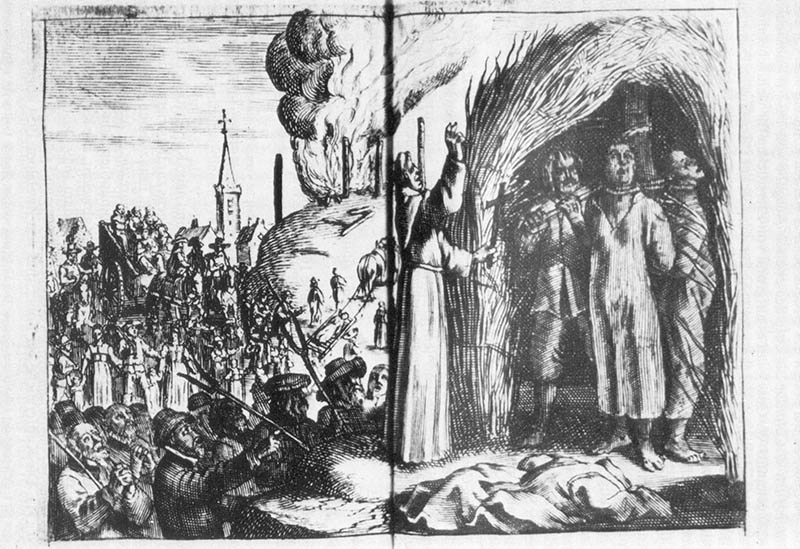
Bohemia, Moravia and Silesia weren’t spared the Witch Trials happening in Europe for almost four centuries. According to the research by the Masaryk university, hundreds of men and women were subjected to these trials in what is now the Czech Republic.
Table of Contents
Witch Trials in Czech Lands
The first documented witch trial was that of a servant girl Anička from Uherské Hradiště. The year was 1494, she was charged with preparing magic potions and executed. In the next four hundred years, around five hundred men and women were tortured and mostly executed based on witchcraft charges. Torture during interrogation often involved the boot, wheel, thumbscrew and burning.
We know it from the movies – common people as well as those who were well-off were charged and tortured as long as it took for them to admit their guilt and to name more people. Being named by another “witch” meant almost certain death.
According to the information we have from the Black books (Smolné knihy in Czech), the most common charge was maleficium which means magic to hurt others. The prosecution claimed that the accused used clothes and bodies of people executed by hanging, bones from the mortuaries, did magic to attract more customers, consorting with the devil. However, the so-called good magic wasn’t viewed as anything better. Making love potions, protecting the cattle or even healing children was punished just the same.
According to the university research (more below), out of 236 cases, 154 were charges of magic to hurt people, cattle or property, 42 was white magic, 26 demonic magic and 14 love-related magic.
Silesia
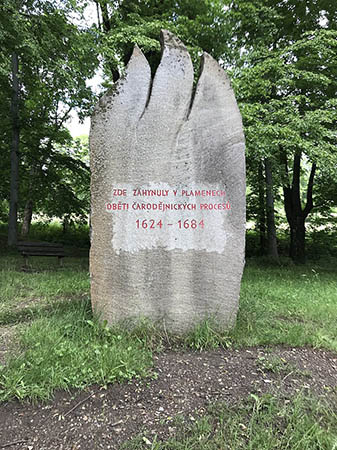
The inquisition processes in the Silesian Duchy of Nysa lasted from 1622 to 1684. They started with a man from Jeseník accusing his wife of killing the cattle with her magic and led to several waves of judicial murders of people from the region. Boblig von Edelstadt was active in a part of these processes, too.
Part of the records was destroyed in the 19th century, the minimum estimate is 350 victims.
Northern Moravia
The region most famous for its witch trials is around Velké Losiny and Šumperk, inhabited mostly by German-speaking citizens. The reason for this could be the fact that the myths of witches came from the neighboring Silesia.
The trials in the Velké Losiny manner started with Gräfin von Galle summoning an inquisitor to investigate the witchcraft allegations. The 17th-century-inquisitor’s name – Jindřich Boblig von Edelstadt – is well known for his cruelty, sadism and the way he led the trials and managed to start with the poorest people working his way up to the wealthy people of the two towns and even the priest and Dean of Šumperk, Kryštof Alois Lauther, who stood up for the accused and whose prosecution was allowed by Karl II von Liechtenstein-Kastelkorn, bishop of Olomouc. Boblig von Edelstadt had around 100 innocent burnt and acquired their property and wealth. This originally secular judge had the support of the clergy as well as the royalty.
|
„Dvě kozy a jeden kozel, všichni mají vzadu prdel. Chceš-li se mnou dneska spát, kozí bobky musíš žrát.”
|
“Two goats and one billy goat,
They all have ass on the rear end. If you wish to sleep with me today, You have to pig out on the goat poop.” |
- Poem translation published in Čechura, Jaroslav: Kronika jednoho šílenství. Praha: Vyšehrad, 2023, s. 121 – Boblig von Edelstadt was a sexual sadist who put emphasis on the vulgarity in his notes.
Bohemia
The witch trials in Nymburk stand out from the trials in Bohemia at the beginning of the 17th century. According to Petr Kreuz, it was the third largest set of trials in an ethnically Czech region. From the 20 people who were prosecuted, 10 were executed by decapitation by sword, 9 of them being men.
Mostly Women
As women were considered weaker and more susceptible to the devil’s luring, they were the majority of the victims. Southern Moravia was the region with the most witch trials and more than 90 % of the accused were women. In places with smaller trial numbers, we can see the proportion of men and women being equal and, in one case, the number of men was higher.
In 1644, Prague’s Lesser Town (Malá Strana) witnessed a witchcraft trial involving children, when nineteen boys from the Jesuit school were accused of invoking the devil. They were acquitted by a committee composed of ethnic Czechs and Germans who also refused to subject the children to torture during the investigation.
Did they really do magic?
As mentioned here, the historians’ opinions differ. Jaroslav Čechura believes that in the Jeseník region (Northern Moravia), there was a sect that gathered on the Petrovy kameny hill to celebrate their witch sabbaths. Michaela Neubauerová fromt he Regional archive, however, considers this theory to be a nonsense.
Research
Researchers from the Masaryk university compiled a digital dataset of witchcraft trials in 1491 – 1785, covering 257 cases. According to their estimate, archival work could reveal further ca. 250-800 cases.
Aleš Vojíř created interactive maps with basic information based on the data by the Center for the Digital Research of Religion . In the following map, you can see where the witch trials took place:
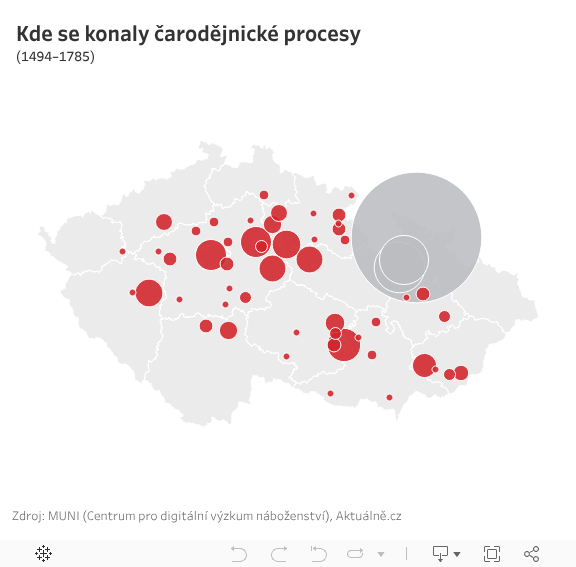
In this map, you can see the year and place of the trial, name of the person, sometimes their profession and punishment (or release). These are the translations of the most common punishments:
upálen/a – burnt
popraven/a – executed
pohřben/a zaživa – buried alive
vězení – prison
propuštěn/a – released
sťat/a – decapitated
vpleten/a do kola – wheeled
lámán/a – broken
(3) šnyty na zádech – (3) cuts on the back
(3) týdny nucených prací – (3) weeks of forced labor
rozčtvrcen/a – dismemberment in 4 pieces
smýkán/a koněm – dragged by a horse
utětí pravé ruky – right hand cut off
The following chart shows each case in more detail, you can search by sex, charge and sentence (in Czech):

Witch Trials in Popular Culture
The inquisitor Heinrich Kramer’s Malleus Maleficarum (in Czech Kladivo na čarodějnice) was well-known in the Czech lands and inspired several pop culture works. The most famous perhaps being the 1963 book Kladivo na čarodějnice (The Witches’ Hammer) by Václav Kaplický and the 1970 movie Kladivo na čarodějnice (Witchhammer) by Otakar Vávra. This movie tells the story of several characters being involved in the witch trials in the 17th century in Velké Losiny and Šumperk, including the aforementioned Boblig von Edelstadt and the way he worked his way up from a beggar who stole a host from the church to the rich people of the area.
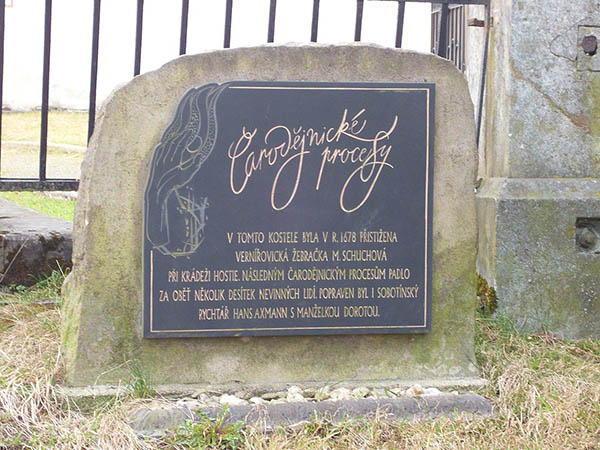
Nowadays, we celebrate a ritual called Burning of the Witches.
Featured picture: Volné dílo, https://commons.wikimedia.org/w/index.php?curid=365347