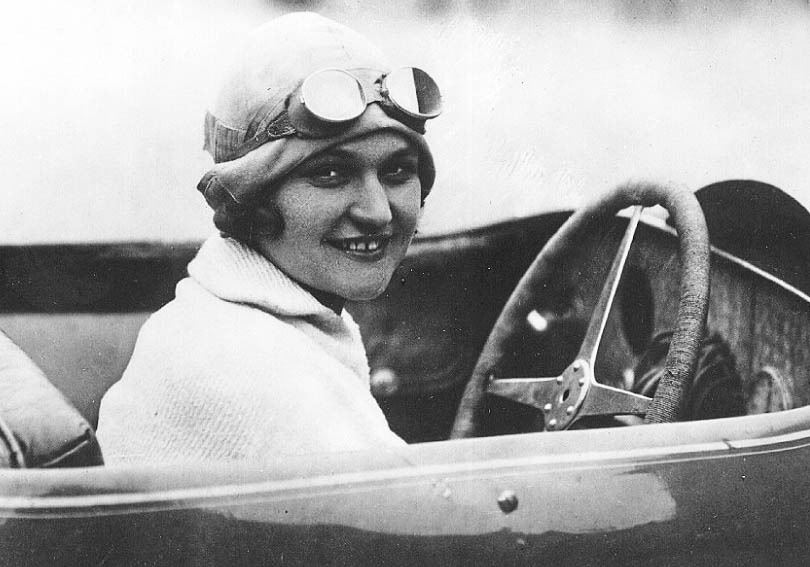
Despite of being behind the wheel of race cars for only 5 years, Eliška Junková is remembered as the most successful Czech female race car driver of all times.
Table of Contents
Destined for something else
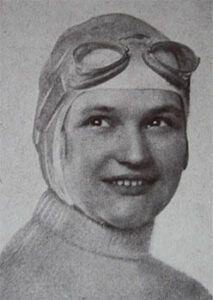 Junková was born in Olomouc on the 16th of November 1900 as Alžběta Pospíšilová. Since she was small she knew she wanted to travel and decided to learn languages. She spoke German well since childhood and focused also on English. She started working in a bank at the age of 16, a decision which would ultimately change the course of her life. Her superior, Čeněk Junek, not only took her with him to a new branch in Brno but later, they became a couple and married. At the wedding, not only her surname changed but also her given name. As her name Alžběta was translated into English as Elisabeth, she was often called Eli and so she decided to change her name to Eliška, an alternative of the name Alžběta.
First travels
Before she married, Junková used her time in Brno to learn languages and study music under Leoš Janáček. After moving to Prague and completing her internship in France, she had plans to visit Ceylon. These, however, were cut short by Spain who refused her entry (she wanted to travel to Ceylon via Gibraltar), as well as Great Britain who refused her a visa (to work on a ship headed for Ceylon).
She and her future husband met during her stay in France at the Paris Motor Show, Junek was already a dedicated race car driver. They both fell in love with Bugatti T30 which they later acquired. After returning to Prague, young Alžběta got her driver’s license in secret.
Racing career
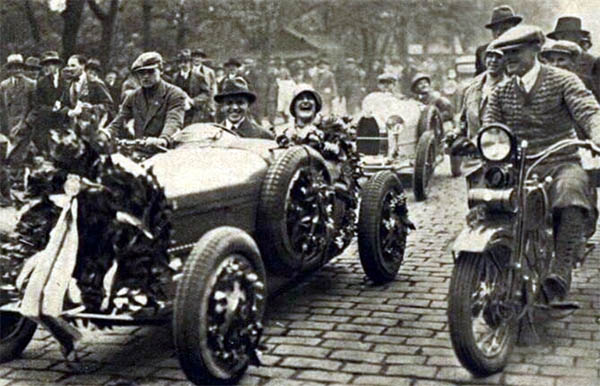
Junková participated in her first race in April of 1923 already as a married woman and a co-driver of her husband who supported her chosen path. They celebrated several triumphs together (e.g. on the famous race Lochotín-Třemošná) before she started racing alone in September of 1924. She won her category on the Lochotín-Třemošná race in 1924 and then dominated the Zbraslav-Jíloviště race a year later. She won many more races in the upcoming years, as did her husband and finished second in the Swiss Klausenpassrennen in 1926 and fourth in the German Grand Prix in Nürburgring in 1927.
Many more successes followed, the most memorable perhaps being her participation in Targa Florio in Sicily, Italy, in 1927 and 1928. She had to step down from the race the first time because of technical difficulties (despite of being second before she did) and in the upcoming year, she finished fifth after being on the lead of the most part of the race. After this success, she started being described as the “Queen of the Steering Wheel” in her homeland.
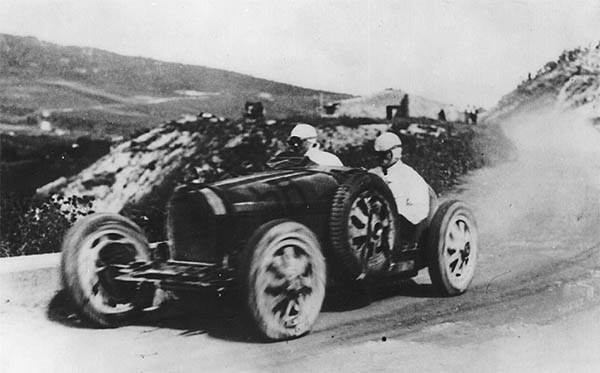
The year 1928 brought another big change in her life and career. Her husband had an accident at the German Grand Prix and lost his life. Junková never raced again.
Off to Ceylon and other adventures
After loosing her husband, she decided to do the trip she always wished for. Ettore Bugatti, the owner of the Bugatti brand, gifted her a brand new car and asked her to explore the export possibilities to India and Sri Lanka.
After returning home, she was involved in the world of race cars, though not as a driver anymore. She was at the planning of Masaryk circuit in Brno for which she attracted important personalities. She also worked as interpreter of English, German, French and Italian.
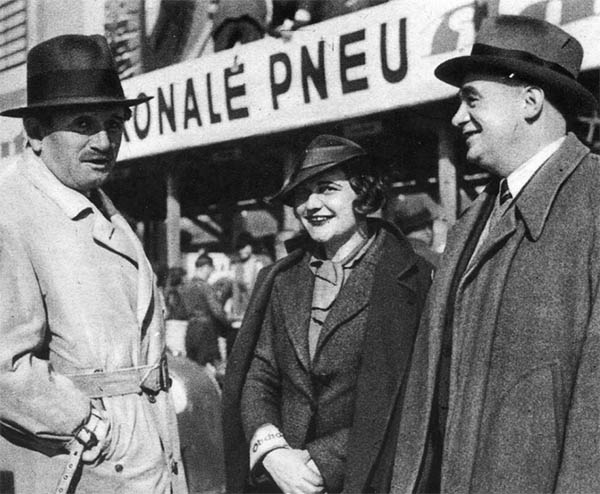
She started her employment with the company Baťa in 1933 (you might know Baťa as a shoe manufacturing company but they also produced car tires) and worked as a leader of their commercial department. Later she worked in related areas and she’s the author of the tire brand name Barum.
Although she didn’t have children of her own, she adopted her orphaned nephew Vladimír who adopted her surname and proudly continued his adoptive mother’s legacy until his passing. She wasn’t allowed to travel abroad after the regime changes of 1948 and her first travel after 18 years was in 1966 to Sicily. She re-married after the end of WW2 and became Eliška Junková-Khásová.
Junková lived from 1928 until the end of her life on Úvoz 13, Prague, nowadays the address of the Embassy of Sweden.
Portrait: Author: Unknown– Album representantů všech oborů veřejného života Česko-Slovenského, hlavní redaktor prof. Fr. Sekanina, vydalo Umělecké nakladatelství Josef Zeibrdlich, Praha I., Bílkova 17, 1927, Volné dílo, https://commons.wikimedia.org/w/index.php?curid=11248631