Are you looking for a traditional Czech name for your baby or are you just interested in the oldest Czech names? Here are some of the oldest ones.
Some of these names are not in use anymore, others are still very popular. The following are the oldest of Czech names.
Would you like to know what the most popular Czech names are at the present? Read Most Common Czech Baby Names. And if you’d like to know more about Czech surnames, here’s the Guide to Czech Surnames – Where did they come from, what do they mean and what are the strangest ones?
Some of the following names are purely of Czech origin, while you can find versions of others throughout the Slavic countries and we cannot say exactly which language or place those names come from. We can say, however, that all of these names have been used on the territory of the present Czech Republic for centuries. All the statistics on names end in 2016 due to GDPR. Those names which can still be found in the Czech civil calendar will be written in bold. An interesting fact is that some names can be found in the calendar only in their male or female form and sometimes, the male and female form of a name has its name day on a different date.
Old Czech Names
The oldest Czech names we know are from the historical characters of the 13th century (names of royals) and legends from even earlier times. We have all heard the legend of duke Krok (meaning “step”) and his three daughters Kazi, Teta (meaning “aunt”) and Libuše, the latter becoming the famous Bohemian queen-prophet who married Přemysl. While you wouldn’t find the names of the two older sisters in the Czech civil calendar and you wouldn’t probably be able to find a person with one of those names (2016: Kazi – 15, Teta – 0), the names of the queen and her husband are still quite popular.
 Other historical figures whose names we use today are the famous king Václav (Wenceslaus), and the royals and now saints Vojtěch and Alžběta.
Some long forgotten names are Lepej, Ledan, Lahut or Léva. And from the same sort, although still popular today, is the name Ladislav.
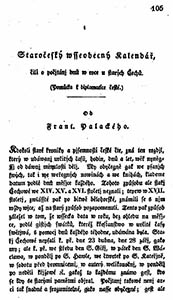
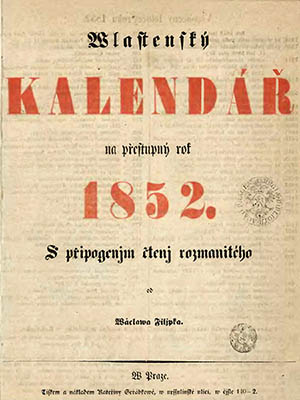
The first somewhat official list of old Czech names was drafted by František Palacký and published in 1832 in the magazine Časopis českého museum.
How old Czech names were formed
Names were often formed as an expression of a person’s prominent feature or the social status which sometimes resulted in names that brought rather shame but we will talk about those later. Other names derived from those characteristics would be, for example Živan or Bujan.
Often times, male names were meant as a celebration of a positive characteristic often attributed to soldiers. Such names are, for example:
- Bohuslav (he who celebrates God)
- Boleslav (more fame)
- Budimír (bringer of the future)
- Ctirad (from čest – honor)
- Dalibor (he who delays the fight)
- Dobroslav (he who celebrates the good)
- Jaromír (he who is famous for his strength)
- Jaroslav (powerful or he who celebrates spring)
- Kazimír (he who destroys or preaches peace)
- Květoslav (he who celebrates flowers)
- Lubomír (he who loves peace)
- Mečislav (he who celebrates swords)
- Miroslav (he who celebrates peace)
- Přemysl (he who thinks carefully)
- Radomil (delightful, caring)
- Vítězslav (he who celebrates victory)
- Vlastimil (he who loves his motherland)
- Vojtěch (army reinforcement)
- Zdislav (he who makes famous)
- Zlatoslav (he who celebrates gold)
Female names from these names would mostly be formed with the addition of -a (Radomil – Rad(o)mila, Zdislav – Zdislava, Václav – Václava).
Name as a burden
Some of the old Czech names are not longer in use for very obvious reasons – they would be a burden to their owners. These names were given based on a person’s features or social status. Such names are, for example Vepřoň (from vepř – pig), Chudoň (from chudoba – poverty), Hlupoň (from hloupý – stupid), Nekrasa (not beautiful), Fena (bitch – from dog), Otroka (from otrok – slave), Chlupava (from chlup – body hair). However, there are names with a rather unpleasant meaning which are still in the Czech calendar, such as Kazimír – there are disputes about the meaning of this name. What comes first to mind is the expression kazit mír – to spoil the peace, although another theory says that the meaning is “the one who preaches peace” (from kázat – to preach and mír – peace). In 2016, there were 58 men named Kazimír who celebrated their name on March 5.
Female names
Some of the old Czech female names not derived from male names are:
- Anežka
- Báta
- Božena
- Ctěna
- Častava
- Dobrava
- Doubravka
- Háta (good, kind)
- Hodona
- Květava
- Lidmila
- Ludmila
- Lubava
- Mlada
- Mnata
- Mrava
- Myslena
- Olota
- Pluahava
- Poděša
- Radla
- Šárka
- Vendula
- Vlasta
- Vlastěna
- Velema
- Živena
- Žerota
Some more names
Just to give you some more old Czech male names (names in bold are in the Czech calendar): Bořivoj, Boček, Bohdan, Budivoj, Ctibor, Ctirad, Častislav, Dalimil, Dobřej, Drslav, Drahoš, Hněvomír, Hostislav, Hostivít, Hořislava, Chranislav, Jaroš, Kazněj, Kostislava, Křesomysl, Lstibor, Milhošt, Miloň, Miloš, Mujmír/Mojmír, Neklan, Nerad, Nezamysl, Pakoslav, Přibyslav, Radek, Radim, Radovan, Rastislav, Slavibor, Soběslav, Soběstoj, Stach, Stojan, Střezimír, Svalovidoslava, Svatopluk, Škoděj, Šulislav, Uhřin, Vladislav, Vladivoj, Všebor, Vacek, Zbyhněv, Zeměmysl
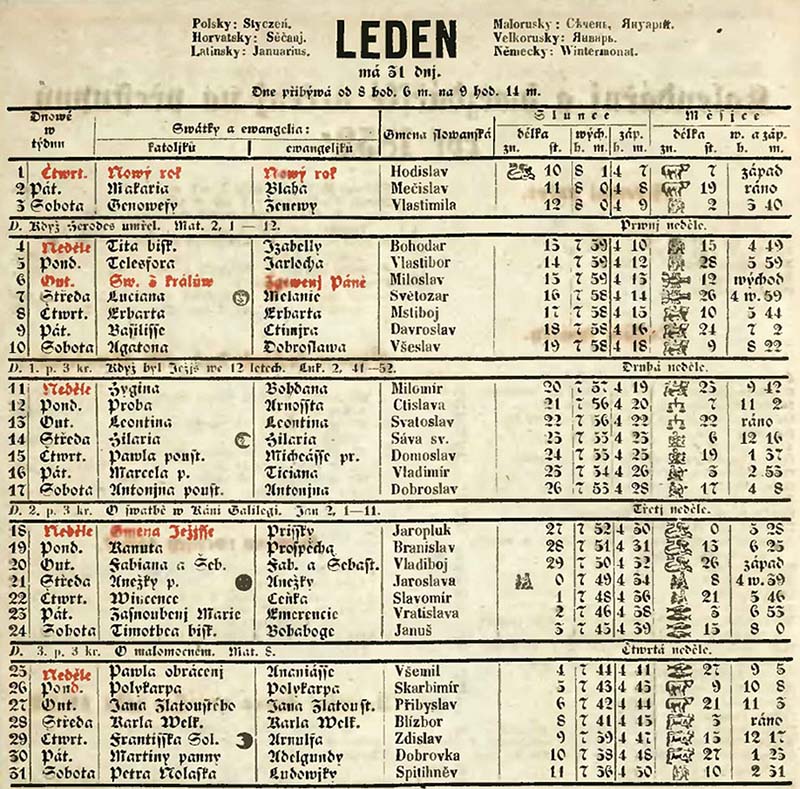
You can find an extensive list of the oldest and mostly forgotten Czec names here (website in Czech) and in the aforementioned first list of old Czech names (website in Czech) and here are those names with their assigned dates.